After four years on the Typepad site, eight years total blogging, Newshoggers is closing it's doors today. We've been coasting the last year or so, with many of us moving on to bigger projects (Hey, Eric!) or simply running out of blogging enthusiasm, and it's time to give the old flying pig a rest.
We've done okay over those eight years, although never being quite PC enough to gain wider acceptance from the partisan "party right or wrong" crowds. We like to think we moved political conversations a little, on the ever-present wish to rush to war with Iran, on the need for a real Left that isn't licking corporatist Dem boots every cycle, on America's foreign misadventures in Afghanistan and Iraq. We like to think we made a small difference while writing under that flying pig banner. We did pretty good for a bunch with no ties to big-party apparatuses or think tanks.
Those eight years of blogging will still exist. Because we're ending this typepad account, we've been archiving the typepad blog here. And the original blogger archive is still here. There will still be new content from the old 'hoggers crew too. Ron writes for The Moderate Voice, I post at The Agonist and Eric Martin's lucid foreign policy thoughts can be read at Democracy Arsenal.
I'd like to thank all our regular commenters, readers and the other bloggers who regularly linked to our posts over the years to agree or disagree. You all made writing for 'hoggers an amazingly fun and stimulating experience.
Thank you very much.
Note: This is an archive copy of Newshoggers. Most of the pictures are gone but the words are all here. There may be some occasional new content, John may do some posts and Ron will cross post some of his contributions to The Moderate Voice so check back.
On Tuesday, the military contractors behind the "Second To None" campaign pleaded "no comment" to our War Costs campaign's full-page Politicoad exposing the economic damage caused by massive war budgets. The same day, they announced a press conference and the upcoming launch of a national campaign to scare people about job losses if we cut the war budget. It seems like they had a comment or two after all. But as these companies gather at the National Press Club on Wednesday morning to frighten you into funding their trust funds, remember: military spending costs us jobs compared to other ways of spending the money.
These contractors will undoubtedly try to obscure the fact that every $1 billion of military spending costs anywhere between 3,200 and 11,700 jobs or more when compared to other ways of spending the money. They'll probably also try to obscure the fact that because the deficit committee has to find spending reductions equaling a certain dollar amount, this is a zero sum game, pitting military spending against the exact kinds of spending that would create more jobs. If the industry is right, and we should be coming at the question of where to cut spending from the perspective of job creation, then we have to cut war spending because other cuts would cost even more jobs.
Reporters should also keep in mind that these folks have a history of fudging jobs numbers when they feel it's expedient for their profit margins. For example, back when Second-To-None-backer Lockheed Martin was trying to secure additional taxpayer dollars for its F-22 fighter jet in 2009, the contractor grossly inflated the number of jobs sustained by the program. The actual job numbers should have been less than 40 percent of those claimed by Lockheed. When this industry comes at you with jobs numbers, caveat emptor.
All this assumes, of course, that we buy the war industry's spin that for them, it's all about the workers. If one looks at these companies' histories, that's an absurd assumption. The organization through which the industry organized the Second To None campaign, the Aerospace Industries Association (AIA), includes on its executive committee representatives of companies which have paid more than $130 million in labor-related fines and settlements in the last 10 years, according to the Project on Government Oversight's contractor misconduct database. These violations include sexual harassment; Americans with Disabilities Act actions; federal safety standards violations; wrongful termination; age, sex and racial discrimination; and whistleblower retaliation.
Almost all of the above war industry misbehavior takes place on the government dime, of which the companies behind Second To None and AIA are very, very poor stewards. Their leadership [.pdf] includes executives at three of the companies cited by the recent Wartime Commission on Contracting's eye-popping report [.pdf] on the waste of $60 billion: DynCorp, ITT Corporation and L-3 Communications (The report discusses "ITT Federal Services," which is a subsidiary of ITT Corp.). In addition, the companies represented on AIA's executive committee have been responsible for a bucket-load of documented misconduct in federal contracting worth more than $5.7 billion since 1995, according to POGO's database.
We're having a hard time here understanding why we should look to the corporations behind Second To None to hire workers or spend our hard-earned money. Maybe they'd like to comment about that.
The Afghanistan War costs American taxpayers more than $2 billion a week at a time when communities are falling apart, and our mayors are fed up. On Monday, the United States Conference of Mayors is expected to pass a resolution calling for a speedy end of the Iraq and Afghanistan Wars so we can use those funds here at home. The mayors are exactly right.
Citizens of Lansing, Michigan, paid $114.2 million on the Afghanistan War so far, and New York City paid $15.4 billion; these cities are about to have to close fire stations.
Montgomery, Alabama paid $199.3 million and Philadelphia, Pennsylvania paid $1.7 billion; these cities are laying off teachers.
Minneapolis, Minnesota paid $692.3 million; now they can't fill potholes.
And here's the big picture: "Local governments shed 28,000 jobs last month, the Department of Labor reported, and have lost 446,000 jobs since employment peaked in September 2008."
These wars are killing our people, they're killing our economy and they're killing our communities. They're not worth the costs. They've got to end.
The Defense Department is working overtime to stop any real drawdown from either country. They're trying to fool us into thinking they've started a "drawdown" already by shuffling troops from Afghanistan to Kuwait (read: Iraq). They're pushing for a fig-leaf withdrawal of a few thousand troops. That's unacceptable.
Next week, President Obama is expected to make an announcement about his intentions for a troop drawdown from Afghanistan. He needs to do the right thing by our troops and by our communities and end these wars for good, starting with a major, swift and sustained withdrawal of troops from Afghanistan. Enough is enough.
If you're one of the millions of Americans who want to end the Afghanistan War, join Rethink Afghanistan on Facebook and Twitter.
As President Obama prepares to announce his intentions for how many troops to withdraw from Afghanistan this year, public opinion polls show the ground is moving under him. Over the past few days, several new surveys show a significant spike in the number of people who want to see big numbers of troops brought home. The war isn't making us safer and it's not worth the costs, and following Bin Laden's death it's become impossible for the American people to make sense of keeping troops fighting and dying in Afghanistan.
Two separate polls taken on June 3-7 by different firms show a significant shift in public opinion:
A CBS News poll shows a 16-percent increase in the number of people who think troops levels should be decreased (64 percent, vs. 48 percent last month in the same poll).
A survey by CNN shows a 9-percent jump compared to last month in the number of people who say the U.S. should withdraw all of its troops.
The CBS poll also showed that a whopping 73 percent of Americans believe the U.S. should withdraw a "substantial" number of troops from Afghanistan this summer.
These polls show a major move in public opinion as we approach the president's deadline for the start of troop withdrawals; the American people are practically yelling at the White House to get troops home.
The CNN and CBS surveys also put into stark relief just how badly Washington, D.C. politics lag behind U.S. public opinion. None of the numbers bandied about over the past few weeks by public officials come close to being "significant" withdrawals. Senator John McCain says only 3,000 troops should be withdrawn, a paltry number that's even smaller than the 5,000 troops suggested by an unnamed military official several weeks ago. Senator Carl Levin says 15,000 would be a better number, but that number wouldn't even reverse President Obama's first escalation of 17,000 troops, much less the 30,000 he sent in early 2010. Keep in mind, these numbers are in comparison to military force of well over 100,000, not including private security companies. The highest number among these anemic proposals, Levin's 15,000, would leave more than 85 percent of U.S. troops in Afghanistan by the end of this year. That's a fig leaf, not a significant troop withdrawal.
The Afghanistan Study Group's proposal comes much closer to the sentiments of the American people. They propose "ceasefires, large troop reductions (30,000 this year, 40,000 in 2012), reformation of the Afghan government, and political negotiations within Afghanistan and amongst its neighbors to stabilize Afghanistan and the region, and to begin to get the United States out of Afghanistan's quicksand."
There's a major groundswell building across the country for ending this war, and as the president prepares to announce his intentions for the Afghanistan War, he better pay attention.
If you're one of the millions of Americans who want to bring troops home from Afghanistan, join Rethink Afghanistan on Facebook and Twitter.
Memorial Day is a national holiday dedicated to remembering Americans killed in wartime. This year, unfortunately, we remember war dead who didn't have to die, and unless Congress and the president act, we'll remember more needless deaths next year. As of today, 1,516 Americans have died in the Afghanistan War, a conflict that the American people oppose and the continuation of which makes no sense.
Hidden from the front pages of newspapers and other media who can't be bothered to devote significant coverage to the longest war in U.S. history, these dead troops had names and lives before our national policies forced them to give them up.
For example, 23-year-old Army Pvt. Thomas C. Allers from Plainwell, Michigan, was remembered as a "great kid, very sweet," who enjoyed fishing with his parents. He died this week alongside Staff Sgt. Kristofferson B. Lorenzo, 33, of Chula Vista, California; Pfc. William S. Blevins, 21, of Sardinia, Ohio; and Pvt. Andrew M. Krippner, 20, of Garland, Texas.
These men didn't have to die. They died because our politicians sent them to Afghanistan over the continued objections of their countrymen. Their comrades will continue to die until those politicians bring them home.
In a bitter moment of irony this week, the U.S. House of Representatives narrowly failed to agree to amendments that would have reined in the brutal, futile war on the same day U.S. troops were suffering their worst losses in Afghanistan since Bin Laden's death. But, as Robert Naiman points out, even though McGovern/Jones amendment to the National Defense Authorization Act failed, the vote margin was so narrow (204-215) that it sent a strong signal to the president that Congress' patience with the constantly deteriorating and resource-hungry war was running out. As U.S. Rep. John Mica (R-Fla.) put it, "[W]hen somebody comes up with the right amendment, it's going to pass."
The American people's patience ran out long ago, however. For months, poll after poll has shown rock-solid opposition to the Afghanistan War. Since last December, for example, Pew Research Center's polling has consistently shown that at least a plurality (hovering around 50 percent) want to "remove troops ASAP." With Osama Bin Laden dead and al-Qaeda driven from the country, it's time Congress and the president listened.
Today, we remember Americans killed during the Afghanistan War. Below are the names of the troops who died in that conflict just since last Memorial Day. Congress and the president need to act to end this war immediately so that next year's list is drastically shorter. Please take a moment to sign our petition to bring the troops home.
A quiet city in the north of Afghanistan ignited today after yet another NATO night raid reportedly tore another family apart. Thousands of people took to the streets, again chanting, "Death to America!" as they pelted Karzai's billboards with mud and stones. They attacked police. They attacked the local NATO outpost. At least a dozen people were killed in the clash, which showed local rage directed at every level of the U.S.-led counterinsurgency strategy, from the local security forces, to our corrupt and feckless local "partners" in the Karzai government, to the U.S. itself.
Worse, this isn't the only civilian killing by NATO forces even just this week. On May 16, Reuters reported:
"Foreign troops killed an Afghan child and wounded four others when responding to insurgent fire in volatile eastern Kunar province, the provincial Governor said on Monday, the third accidental killing of young civilians in less than a week."
These deaths were senseless enough before Bin Laden was killed and al Qaeda driven from the country. Now, they're downright obscene. With the last rational-sounding excuse for continuing the war, bringing Bin Laden to "justice," gone, continuing this counterinsurgency campaign makes no sense, and it's making Americans and Afghans less safe while wasting precious national resources. If you agree, please join Rethink Afghanistan in calling for an end to the war in the wake of Bin Laden's death.
The uprising in Taloqan triggered by NATO's killing of civilians is a microcosm of a larger dynamic playing out across the country. When one honestly looks at the data, the counterinsurgency campaign in Afghanistan has been, at best, a miserable failure in its stated goal of "protecting the population," or worse, a key driver in an ever-increasing cycle of violence and instability that puts civilians at risk.
Rising Violence in the Shadow of Escalation
Despite an escalation launched under the pretext of "reversing Taliban momentum" and "protecting the population," attacks launched by insurgents and civilian casualties continue to rise. U.S. military leaders expect those numbers to continue to worsen over this summer. This is a strategy, remember, that Admiral Mike Mullen said, "must -- and will -- improve security for the Afghan people and limit both future civilian and military casualties."
Both civilian and military casualties have increased sharply following the escalation, by the way.
A new report published by the Minority Rights Group International shows the price paid by Afghans for the U.S. catastrophic pursuit of escalated military action as a solution to the Afghanistan crisis. MRG says that Afghanistan's population has seen a bigger spike in risk for mass killings than any other country on the planet this year. The military-first strategy for resolving the Afghanistan conflict hasn't made Afghans safer, at best. At worst, it raised the temperature of the conflict to a boil.
We sold the Afghans a bill of goods--that a huge influx of military forces was what was needed to protect them. As Rethink Afghanistan warned at the time, there was no way an escalation was ever going to mean more safety for people caught in the crossfire. Combine that false promise with the U.S.'s continued backing of deeply corrupt thugs in Kabul, and it's easy to understand why the Afghans are angry. The longer this dynamic persists, the less safe Americans become.
Meanwhile, special forces night raids continue all over the country, generating rage, humiliation, and needless death, at the cost of more than $2 billion a week and senseless military and civilian casualties.
The uprising in Taloqan wasn't the first, and unless the U.S. begins a serious drawdown of forces and ends these night raids, it won't be the last.
The Pentagon is working the press again, this time in support of a so-called withdrawal plan that would break a promise made to the American people by their president. According to The Wall Street Journal:
"U.S. military officers in Afghanistan have drawn up preliminary proposals to withdraw as many as 5,000 troops from the country in July and as many as 5,000 more by the year's end..."
This joke of a "withdrawal" plan isn't anything remotely approaching a real drawdown. It's less than a 10 percent reduction in U.S. forces in Afghanistan over 6 months. It puts the Pentagon squarely at odds both with the stated desires of the White House and the very clearly articulated will of the American people. If you agree, sign Rethink Afghanistan's petition to get the troops out of Afghanistan.
First, let's remember what the White House said on this:
"After 18 months, our troops will begin to come home....[O]ur troop commitment in Afghanistan cannot be open-ended -- because the nation that I'm most interested in building is our own."--President Barack Obama, Dec. 1, 2009.
"I'm confident that the withdrawal will be significant. People will say this is a real process of transition; this is not just a token gesture."--President Barack Obama, April 15, 2011.
The American people are and have been crystal-clear about their expectations for a drawdown for months now.
Rasmussen Reports' latest polling (published on May 9, 2011) shows that 56 percent of likely voters want troops brought home within a year, and more than half of those want all troops withdrawn immediately. The number of likely voters who want troops home within a year has increased by four percentage points since the beginning of March.
An NBC News poll taken May 5-7 shows that 56 percent of Americans disapprove of leaving some troops in Afghanistan until 2014.
These are not ambiguous numbers. Heading into a presidential election season, likely voters and Americans in general are telling pollsters and their elected representatives that they expect a real troop withdrawal, with most of them wanting troops out within a year. The Pentagon's draft plan isn't remotely in the ballpark of what the American people want.
Bringing home 5,000 people in July and maybe another 5,000 people by the end of the year is an insignificant, token withdrawal from a force of well over 100,000 U.S. forces in Afghanistan. It's less than a 10 percent adjustment of the American personnel on the ground. The Pentagon is telling the White House and the American people to take a hike.
Osama Bin Laden is dead. Al Qaeda has been driven from Afghanistan. The last plausible excuse for keeping troops in Afghanistan is gone. Yet, the military continues to fight a counterinsurgency campaign with tens of thousands of U.S. troops, a campaign that's failed to blunt the ever-growing level of insurgent attacks across Afghanistan. Civilian casualties are at an all-time high. Troop injuries and acute stress are at an all-time high in the war. Costs are at an all-time high. There's no rational reason left to continue this farce.
The Pentagon's token troop adjustment would break a promise made to the American people by their president, and it would blatantly flout the will of the voters. The "plan" is laughable and should be rejected by the White House. President Obama and Congress must demand a real plan to get the troops home as swiftly and safely as possible.
"In Afghanistan, we will continue taking the fight to al-Qaida and their Taliban allies, while working to support the Afghan people as they build a stronger government and begin to take responsibility for their own security... Our message to the Taliban remains the same. You cannot wait us out, you cannot defeat us, but you can make the choice to abandon al Qaeda and participate in a peaceful political process."
Translation: Business as usual in Afghanistan, move along. Her remarks promise more of the same broken policies that have kept us mired in the Afghan much for a decade now. Clinton's tough talk and saber-rattling at the Taliban in her full remarks won't lead to real reconciliation or clear the paths for peace talks, and it won't bring troops any closer to home. That's not where most Americans were while Bin Laden was still at large, and it's certainly not where they are now that he's gone, as evidenced this week by the tens of thousands of people signing our petition to bring troops home.
Think about it. Al-Qaeda is driven from Afghanistan, according to General Petraeus. Osama Bin Laden is dead. How do you justify to the American people the continued deployment of their loved ones in Afghanistan and the $2 billion we're spending to occupy the country?
Are you going to sell them on the benefits of supporting the corrupt, feckless Karzai Administration?
Will the American people suddenly turn around and support a massive troop deployment they already opposed in huge numbers while Bin Laden was still at large?
We doubt it.
Secretary Clinton may be trying to look tough, but she and the others failing to see Bin Laden's death as a major pivot point are severely out of step with the people they're supposed to represent.
When news broke that President Obama was about to announce the killing of Osama Bin Laden, we posted the following on our Rethink Afghanistan Facebook page:
"President Obama is about to announce Osama Bin Laden is dead. Click 'like' if you think it's time to get the troops home."
About 2,000 people clicked "Like" within 12 hours.
After the president finished his speech, we launched a "Bring the Troops Home" petition on RethinkAfghanistan.com, urging the president to use this moment as a pivot point to begin a swift troop withdrawal. Within a day, we already had 20,000 signers, and that number continues to grow rapidly. The petition has been featured and debated in the media, including The New York Times, MSNBC, CBS, and other outlets. This rapid outpouring of desire to see troops brought home following Bin Laden's death shows that people want the Afghanistan War wrapped up, not extended until 2014.
The pro-Afghanistan-War dead-enders are busy behind the scenes in Washington trying to prevent any serious rethinking of the occupation of Afghanistan, even though the counterinsurgency campaign wasn't responsible for Bin Laden's capture or killing, nor has it brought the promised security for the Afghan people. But, inertia is a powerful force, and unless we continue to keep the pressure on to start real troop withdrawals, these bitter-enders will persuade elites in Washington that nothing needs to change.
Maintaining the status quo in Afghanistan would be both a policy and a political disaster for our country. Insurgent violence continues to rise at an extraordinary rate year after year, and it's clear that the counterinsurgency campaign is failing. Meanwhile, Americans all over the country are asking the same question as Spc. William Baxter, a parachute rigger with the 101st Sustainment Brigade:
"OK, he's dead, can we go home?" he asked.
With Americans rightly expecting this war to end, the answer better be, "Yes."
While millions of Americans are out of work or struggling to pay their bills, our government is spending billions of dollars a week on a war we don't support in Afghanistan. At no time is this more apparent than on Tax Day, which is coming up on April 18.
Oliver Wendell Holmes once famously said, "Taxes are what we pay for civilized society." But unfortunately, they're also what we pay when our elected officials make huge, expensive mistakes, and in this case, use lots of expensive weapons to kill people. According to our friends at the National Priorities Project, 27.4 percent of our income taxes will go to pay for the Afghanistan War and other military spending. Already the taxpayer is on the hook for $107.3 billion just for this year, and just for the hugely expensive Afghanistan War. Those billions of dollars are supposed to help us build up our community and lay the groundwork for a brighter future for our children but, instead, they're being used to fight a war the American people don't support.
President Obama likes to talk about "winning the future" these days, but the U.S. is in a losing situation in Afghanistan. We're bleeding wealth and lives at an unacceptable rate, and things are only expected to get worse this year as fighting season resumes in the spring. Meanwhile, the Pentagon and their political allies want the president to ignore the clear will of the American people, who want troops out within a year. The military is reportedly pushing the president to pull out only an "insignificant" number of troops, despite the fact that it will cost us $1 million per troop to keep forces in Afghanistan this year. Bleeding that many resources on a war that's not making us safer all the way until 2014 is losing, regardless of what General Petraeus' spin shop tells us. We're losing the future in Afghanistan.
So what would "winning the future" look like in Afghanistan?
At bare minimum, winning the future would mean recapturing the resources meant to be spent on war and putting them to use rebuilding our battered communities. Winning the future would mean unhooking our country from a decade-long war and being more free to pursue objectives that are actually in our national interest, instead of going with the inertia of a 10-year-long mistake. In short, winning the future means getting our troops out of Afghanistan.
Many of us are about to write checks to the IRS, and we're about to do it at a time when, frankly, we don't have a lot of money to spare. That's why it's important that we take a good, hard look at where our dollars are going and make sure our elected officials hear from us when they make bad decisions that waste scare resources. Please take a minute to use the new Afghanistan War Tax Calculator to find out how much you paid in taxes for war, and use our tool to forward it on to your Member of Congress. It's time Congress got the message that we want this wasteful war stopped, now.
If you're tired of this war that's not worth the costs, join Rethink Afghanistan on Facebook and Twitter, and find others in your hometown who oppose this war at your local Rethink the Afghanistan War Meetup.
When testifying before the Senate Armed Services Committee, General David Petraeus told senators that he understood the frustration with the Afghanistan War, conceding that "we have spent an enormous amount of money." The general has a gift for understatement.
We are spending $2 billion a week on this futile, brutal war that's not making us safer, and even that "enormous" amount of money (to say nothing of the lives lost or broken) hasn't hammered the square peg of a military solution into the round hold of the crisis in Afghanistan. News flash: if you can't turn the war effort around with 30,000 more troops at a cost of $1 million per troop, per year, maybe the military solutions aren't solutions after all.
Millions of Americans are still burning in an economic hell while our leaders waste precious resources on Hellfire missiles. Just one statistic drives it home: the poverty rate for children in the U.S. may soon hit 25 percent. And while those kids are living in hotels or on the street, or wondering where their next meal will come from, Petraeus will keep right on "understanding" your frustration while he spends almost $10 billion a month that could be used right here at home, getting those kids and their families back on their feet. We can't let that happen.
Brave New Foundation's Rethink Afghanistan is fighting to get the truth out about this war while the mainstream media sleeps on it. If you're fed up with this war that's not making us safer and that's not worth the cost, join Rethink Afghanistan on Facebook and Twitter, and join a local Rethink Afghanistan Meetup. Together we can make sure Petraeus and politicians in Washington, D.C. really understand our frustration and bring our troops home.
General Petraeus and his public relations team reportedly engaged in a scummy attempt to deflect blame for an alleged civilian casualty event on Sunday, suggesting that Afghan parents caught in the crossfire of a coalition raid burned their own children to incriminate international forces. International forces led by the U.S. are accused of killing as many as 60 civilians during a several-day operation in Ghaziabad district in Kunar Province, Afghanistan. Unfortunately, the U.S.-led coalition has a long history of blaming the victims when they get caught in potentially explosive civilian casualty incidents, making this vile accusation particularly hard to believe.
To the shock of President Hamid Karzai's aides, Gen. David H. Petraeus suggested Sunday at the presidential palace that Afghans caught up in a coalition attack in northeastern Afghanistan might have burned their own children to exaggerate claims of civilian casualties, according to two participants at the meeting.
[Unnamed sources in the room for the conversation] said Petraeus, the top U.S. commander in Afghanistan, dismissed allegations by Karzai's office and the provincial governor that civilians were killed and said residents had invented stories, or even injured their children, to pin the blame on U.S. forces and force an end to the operation.
Has Petraeus lost his mind? One better have some pretty solid evidence before accusing people who may have lost children or seen them badly injured of lying of hurting their own kids. From what I can tell, there's no evidence of parental abuse being responsible for the reported injuries of children. Petraeus and his spin shop are trying to get ahead of the story, throwing multiple possible accounts of what happened into the mix to blunt the outrage that will surely result when a story about an awful set of civilian killings hits the news. But lacking hard evidence, Petraeus' hypothetical seems ugly and vicious, relying on pervasive notions of Afghans as backward and barbaric to escape accountability.
A Pattern of Blaming the Victim
International Security Assistance Force (ISAF) press flak Rear Adm. Greg Smith claimed to have watched video of the attacks and said everything was just peachy:
During the next five hours, Smith said, surveillance drones tracked the fighters while the Apaches fired 30 mm Gatling guns, rockets and Hellfire missiles. "I have reviewed the footage and found no evidence women and children were among the fighters," he said. "Again, no civilian structures were anywhere near where these engagements took place. It was at night and in very rugged terrain."
And yet...
On Saturday, Wahidi, the provincial governor, sent a three-person fact-finding team up the valley to the village of Helgal. They returned with seven injured people, including a woman and a man, both 22 years old, and five boys and girls 16 or younger. Smith said they had burns and shrapnel wounds, none of them life-threatening.
Now, wait a second. Smith says there's no evidence women and children were among the fighters, yet also says that civilians had shrapnel wounds? Then Smith does what he tends to do when there's a potentially attention-getting civilian casualty incident: He blames the Afghan families:
The U.S. military "did have initial reports that the feet and hands of the children appeared to have been burned," Smith said. "We have observed increased reporting of children being disciplined by having their hands and feet dipped into boiling water. No one is claiming this is the case in this instance, but it may well be."
Recall that Smith did the same thing when U.S. special forces killed several Afghan civilians, including pregnant women, in Gardez, whom he said had been discovered "tied up, gagged and killed," presumably by the families of the women.
"[Smith] added, however, "I don't know that there are any forensics that show bullet penetrations of the women or blood from the women." He said they showed signs of puncture and slashing wounds from a knife, and appeared to have died several hours before the arrival of the assault force. In respect for Afghan customs, autopsies are not carried out on civilian victims, he said.
In the Gardez case, Smith was either inventing or conveying bald-faced lies. The women did not die "several hours before the arrival of the assault force." They died after special forces team members shot them, and one of them died while special forces troops dug bullets out of her to cover their tracks.
The footage shows insurgents streaming into homes that were later bombed, said Col. Greg Julian, the chief U.S. military spokesman in Afghanistan. He said ground troops observed some 300 villagers flee in advance of the fighting, indicating that not many could have been inside the bombed compounds... Investigators later reviewed hours of cockpit video from the fighter jets as well as audio recordings of the air crew's conversation with the ground commander. Julian said the military would release the footage and other evidence in the coming days.
Despite Julian swearing he watched hours of cockpit video vindicating the bombers, the U.S. military later admitted (.pdf) that the pilots did in fact kill those civilians after the pilots lost contact with their intended targets before firing.
Pardon me for not jumping to ISAF's defense, after they lied about the use of grenades at the Farah massacre, or claimed the Afghans they shot up at Gardez were "dead when they got there" with bodies stashed near food preparation areas. And pardon me also for not trusting a thing that comes out of Rear Adm. Greg Smith's mouth, the ISAF flak that tried to smear journalist Jerome Starkey for accurately reporting the facts about the Gardez killings. The job of an ISAF public affairs officer is not to tell you the truth, no matter how much that observation provokes their pique. The job of an ISAF PAO is to aid in the war effort by spinning events to the advantage of their side of the conflict. Smith is not a credible source (as proved by the Gardez/Starkey affair, if nothing else) and should be contextualized and held at arms length by any serious journalist.
Enough Spin Already
When asked about reports of his ugly attempt to blame the victims in Ghaziabad: "Petraeus, through a spokesman, declined to comment."
I bet.
ISAF seems to be talking out of several sides of their mouth. Were there no civilians in the area, or did locals in the crossfire invent a story? Did the parents burn their own children, or was there shrapnel in them? And how would shrapnel get into the kids if there were no civilians nearby? This story is still developing, but it bears many of the hallmarks of ISAF's past attempts to warp news coverage after attention-getting reports of mass civilian casualties surfaced.
Enough spin. If ISAF has video of the events in question, it should be made available to the public immediately. There should be an independent UN investigation into the killings and maimings in Ghaziabad, and, unless he has hard evidence, Petraeus should also publicly apologize for trying to deflect blame onto the families who lost loved ones or saw their children injured. Frankly, this kind of talk is tawdry and disgraceful.
Cutting the deficit is all the rage in Washington, D.C., these days, and members of both parties are all too willing to put vital public structures like Social Security and Medicare on the chopping block. The implication is that we can't afford to fund luxurious programs that do extravagant, outlandish things like preventing the elderly from slipping back into a 50-percent poverty rate. This implication is a lie. We have plenty of money. See the so-called "defense" budget for proof.
The Pentagon presently spends more in constant dollars than it did at any time during the Cold War -- this despite the absence of anything remotely approximating what national security experts like to call a "peer competitor." Evil Empire? It exists only in the fevered imaginations of those who quiver at the prospect of China adding a rust-bucket Russian aircraft carrier to its fleet or who take seriously the ravings of radical Islamists promising from deep inside their caves to unite the Umma in a new caliphate.
What are Americans getting for their money? Sadly, not much. Despite extraordinary expenditures (not to mention exertions and sacrifices by U.S. forces), the return on investment is, to be generous, unimpressive. The chief lesson to emerge from the battlefields of the post-9/11 era is this: the Pentagon possesses next to no ability to translate "military supremacy" into meaningful victory.
To illustrate Bacevich's point: We're coming up on the one-year anniversary of the invasion of Marjah by U.S. forces, a move that began the escalated military campaign enabled by President Obama's huge troop increase. What have we gained in that year in Afghanistan?
Country-wide, 2010 was the most violent year of the war so far. Ten thousand people died in war-related violence, including roughly 500 U.S. troops, thousands of civilians and who knows how many insurgents.
We spent roughy 20 million on killing each enemy fighter in Afghanistan. Yet, Taliban growth is such that despite reportedly losing more than 5,000 fighters this year, NATO estimates their numbers remain steady across the country.
Numerous polls show that opposition to the war is at an all-time high, with 63 percent opposing the war. When you do the math, that's more than 196 million Americans who want our troops to come home.
Now, ask yourself, "Are these results worth the $2 billion per week we spent on the Afghanistan War last year?" The answer is very clearly, "No."
Americans have been asking themselves this question this year, if the latest polling from The New York Times and CBS News is any indication. The pollsters were interested in Americans' feelings about whether and how to cut the national budget. The results show that when forced to pick from among various big-ticket government programs, people in the U.S. very clearly prefer cuts to military budgets before items like Social Security and Medicare. Here's the percentages of people who favored cuts in various programs:
military spending: 55 percent
Medicare: 21 percent
Social Security: 13 percent
Here's how they'd prefer to do it, too:
Reduce troops in Europe/Asia: 55 percent
Eliminate weapons programs 19 percent
Reduce pay of veterans: 12 percent
Reduce size of military branches: 7 percent
In other words, if Congress forced the American people to choose how to cut spending, Americans would choose to save money by bringing troops home. If policymakers really wanted to play it safe, they'd start by cutting funds intended to be used to deploy troops to Afghanistan. A whopping 63 percent of Americans now say they oppose that particular war, making it the perfect place to cut first.
It's been almost a year since President Obama launched his escalated military campaign, and we've seen no progress towards our strategic goals in the region. If our policymakers were really serious about cutting wasteful government spending, they'd start with this war that's not making us safer and not worth the costs. Significant troop reductions from Afghanistan this year would not only bring down the deficit in the long run, but also would give the American people what they've been asking for for months: an end to this brutal, futile war.
On Thursday, December 16, 2010, the White House will use its December review to try to spin the disastrous Afghanistan War plan by citing "progress" in the military campaign, but the available facts paint a picture of a war that's not making us safer and that's not worth the cost.
Let's take a look at just the very broad strokes of the information. After more than nine years and a full year of a massive escalation policy:
Pakistan is playing a double game with the U.S. and
the military strategy lacks credible prospects for a turnaround.
And yet, we are told we can expect a report touting security gains and "progress," and that there's virtually zero chance of any significant policy change from this review. It sort of begs the question: just what level of catastrophe in Afghanistan would signal that we need a change in direction?
Insurgency Growing and Getting Stronger
This cat is already out of the bag, no matter how hard the Pentagon tries to reel it back in. In the ironically named "Report on Progress Toward Security and Stability in Afghanistan," published several weeks ago, the Pentagon told Congress that the insurgency's organizational and geographic reach are qualitatively and geographically expanding. This growth is reflected in other statistics. According to USA TODAY, U.S. troops were hit with 7,000 more attacks this year compared to last year. About 3,800 troops were killed and injured by IEDs, about 1,000 more than last year. These statistics depict an insurgency with unbroken momentum, despite administration and military claims to the contrary.
"Despite these huge costs, the situation on the ground is much worse than a year ago because the Taliban insurgency has made progress across the country. It is now very difficult to work outside the cities or even move around Afghanistan by road. The insurgents have built momentum, exploiting the shortcomings of the Afghan government and the mistakes of the coalition. The Taliban today are now a national movement with a serious presence in the north and the west of the country. Foreign bases are completely isolated from their local environment and unable to protect the population."
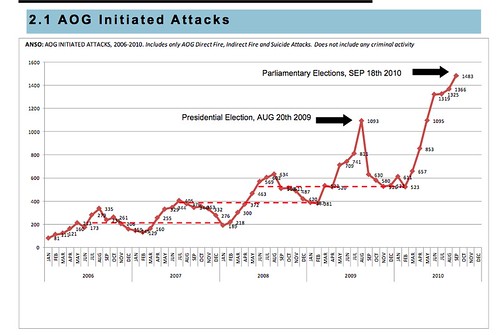
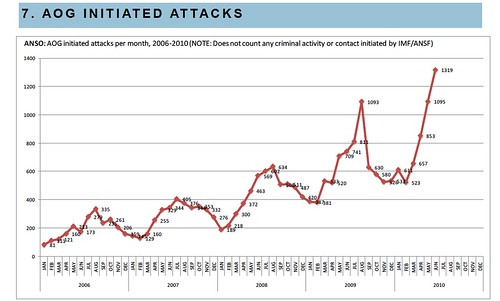
The insurgents' momentum is clearly shown by the number of attacks they've initiated across the country so far this year. According to the Afghan NGO Safety Office (ANSO),
"The [Taliban] counter-offensive is increasingly mature, complex & effective. Country wide attacks have grown by 59% (p.10) while sophisticated recruitment techniques have helped activate networks of fighters in the North where European NATO contributors have failed to provide an adequate deterrent (p.11). Some provinces here are experiencing double the country average growth rate (p.12) and their districts are in danger of slipping beyond any control. Clumsy attempts to stem the developments, through the formation of local militia's and intelligence-poor operations, have served to polarize communities with the IEA capitalizing on the local grievances that result. In the South, despite more robust efforts from the US NATO contingents, counterinsurgency operations in Kandahar and Marjah have similarly failed to degrade the IEA's ability to fight, reduce the number of civilian combat fatalities (p.13) or deliver boxed Government."
Here's a helpful chart from ANSO's report that shows the level of ever-escalating insurgent attacks across Afghanistan.
The White House wants to weasel out of the implications of the data above by saying that the reason the statistics are going south is because, as Petraeus so often says, "when you take away areas important to the enemy, the enemy fights back." So, we're "on offense," as President told troops few weeks ago during his trip to Afghanistan. Well, so what? The 1976 Buccaneers went on offense, too, but that didn't mean they won games.
"One of the iconic exchanges of Vietnam came, some years after the war, between Col. Harry Summers, a military historian, and a counterpart in the North Vietnamese Army. As Summers recalled it, he said, 'You never defeated us in the field.' To which the NVA officer replied: 'That may be true. It is also irrelevant.'"
Pakistan's Double Game
That brings us to Pakistan. According to the New York Times, two new National Intelligence Estimates "offer a more negative assessment [than the administration's upcoming review] and say there is a limited chance of success unless Pakistan hunts down insurgents operating from havens on its Afghan border." But that's some serious wishful thinking, since Pakistan has long used the Taliban as a cat's paw to combat growing Indian influence in Afghanistan. Pakistan wants the militants who threaten it internally suppressed, but it finds the militants who threaten the Karzai regime useful. Fixing that problem would requite U.S. policy follow the roots of their support of the Taliban all the way up to the India/Pakistan animosity, and nothing--nothing--in the U.S.'s military-first strategy comes close to doing so.
These statistics go hand-in-hand with the huge rise in civilian casualties, which number some 2,400 this year so far, according to the Campaign for Innocent Civilians in Conflict.
Time for the White House to Get Real
The Obama administration is kidding itself if it thinks the American people will buy this attempted whitewash of the failure of the escalation strategy in Afghanistan. We are in the grips of a desperate unemployment crisis, wrapped in a larger economic meltdown. We are not ignorant of the $2 billion dollars sent per week on the war, and we want that money, and those young people, back here at home so we put people back to work.
Following the death of Ambassador Richard Holbrooke, the president should take a step back and realize that we all have to travel down that road some day. He should think about what legacy he wants to leave behind him. Postponing a final end to U.S. military action in Afghanistan until 2014 puts U.S. taxpayers and American troops on the hook for an enormous investment of blood and treasure in a failing enterprise with no prospects for a turnaround.
A real, honest review would objectively conclude that the enterprise is failing and that the best alternative is to start removing U.S. troops immediately to stave off continued economic and social damage caused by this war that's not making us safer nor worth the cost.
Please watch our latest video and share it with your friends. Then, join Rethink Afghanistan on Facebook and Twitter.
With General Petraeus' stop on CBS Evening News with Katie Couric now halfway over, it's worth taking a moment to unpack the unchallenged, false assertions and implications he's piled up thus far on his media tour. We decided to look into the claims he made about "oil spots" of "progress" during his interview with NBC's David Gregory. Both claims were absolute fantasies, and the remaining journalists on Petraeus' tour owe their viewers more rigorous skepticism than what we saw on Meet the Press.
Despite Petraeus' use of the term more than a dozen times in his MTP interview, virtually no data that shows strategically significant security "progress" in Afghanistan since the start of the latest escalation. According to the Afghan NGO Safety Office (ANSO), emphasis mine:
...[T]he number of provinces having more than three attacks per day has grown from 1 to 4 while the number of provinces seeing the lowest rate (<1 per 2 days) has dropped from 22 to 19. Overall ANSO assess that, in terms of daily attack rates, 23 provinces have remained stable, 1 has improved and nine provinces have deteriorated being Nangahar, Paktya, Kandahar, Paktika, Uruzgan, Helmand, Ghazni, Farah, Kunduz.
AOG are presenting a formidable geographic presence and are escalating attacks, in areas well outside of IMF main focus, at their own direction and tempo.
Needless to say, if insurgents are initiating many more attacks "at their own direction and tempo," International Security Assistance Force (ISAF) has not "regained the initiative."
But let's talk specifically about General Petraeus' "oil spots."
GEN. PETRAEUS: Well, the oil, the oil spot, if you will, is a, is a term in counterinsurgency literature that connotes a peaceful area, secure area. So what you're trying to do is to always extend that, to push that out. ...[D]own in Helmand Province what we sought to do was to build an oil spot that would encompass the six central districts of Helmand Province, including Marjah and then others, and then to just keep pushing that out, ultimately to connect it over with the oil spot that is being developed around Kandahar City...
The general's visit to Wardak Province today was in part to underline the ...importance of that security bubble being extended from outside Kabul to the southwest here to Wardak Province.
The general, quite frankly, is out of his mind if he wants us to apply a term that means "a peaceful area, secure area" to Helmand (which includes Marjah), Kandahar, or Wardak. None of those provinces are secure. None. In fact, compared to this time last year, they are less peaceful and less secure.
Helmand/Kandahar Region
According to the United Nations Assistance Mission in Afghanistan (UNAMA), southern Afghanistan is in the grip of an ever-escalating insurgent assassination campaign. UNAMA's latest report conveys the local Afghans' perception that the insurgents can strike anywhere, anytime, and that U.S. and allied forces can't protect them. From the report:
The Taliban's use of assassinations increased from an average 3.6 per week and 15.6 per month in the first part of 2009 to on average 7.0 per week and 30.5 per month in the first four months 2010. In May and June, the number of assassinations skyrocketed to on average 18.0 per week according to the UN Department of Safety and Security- Afghanistan.
Helmand (including Marjah)
According to ANSO, the number of insurgent attacks in Helmand province during the second quarter of 2010 spiked to 820, compared to 257 attacks during the same period last year. According to UNAMA, the has effectively prevented provincial authorities from delivering the promised "government in a box" in Marjah, while Operation Moshtarak "has not resulted in increased protection for the civilian population."
UNAMA also slapped ISAF for decreasing civilian security by locating their bases in or near residential areas. ISAF justifies this placement by appealing to counterinsurgency admonitions to "live in and among the population," but UNAMA's report retorts that, because of the locations of the bases,
Afghan civilians face not only the risk of often disproportionate and indiscriminate attacks by AGEs, but also death and injury from mortar and rocket attacks fired by IM Forces that mistakenly fall short of their target and hit residential compounds.
The failure of ISAF to establish security for the residents of Helmand and the ever-growing insurgent assasination campaign combine to make Helmand "the most violent province in the country," according to ANSO.
Kandahar
When Karzai, McChrystal and other representatives of ISAF and the Afghan government held their shuras in Kandahar to win local support, they were told in no uncertain terms that the locals didn't want a military operation brought to their home because they feared it would just drag violence into their neighborhoods. They complained bitterly about ISAF's dismissal of their concerns to UNAMA:
Elders also reported that...these meetings were "photo opportunities" at which the elders' concerns and suggestions were not taken seriously. As one elder from Panjwayi district told UNAMA HR, ".. there are far too many 'meetings in name.' ISAF and the Government ignore what we say, because we are from the districts..[T]his is not true, and it is insulting...[t]here are too often photographers and television cameras at these meetings. In Pakistan, of course, the Taliban can watch television, see me sitting with the governor and decide to kill me. So, when there is a 'meeting in name,' first I risk my life, and then I am insulted."
As ISAF's so-called "rising tide of security" began to materialize, the elders' contended to UNAMA that "ISAF's publication of its plans to launch the military operation caused the Taliban to plant more IEDs and intensify their campaign of intimidation against pro- Government figures." ANSO and UNAMA figures bear out their assertion: Armed opposition groups initiated 559 attacks in the second quarter of 2010, up from 399 during the same period last year, with "more civilians were killed in the region in the first six months of 2010 than in any other region."
Wardak
As for Wardak, ANSO's figures show that, again, attacks were up in the second quarter of 2010 (183 attacks) compared to the same period in 2009 (139). The province is a hotbed for abductions, particularly along Highway 1. In fact, according to UNAMA, "On 15 June, the acting District Governor of Sayadabad district in Wardak province was abducted reportedly by AGEs and later beheaded." Also according to UNAMA:
"[E]lders in Logar and Wardak provinces...said their priority was to end the culture of impunity for civilian deaths and injury from military operations and for those who committed abuses to be held accountable."
And, for the bonus round, rocket fire interrupted Petraeus' shura while Gregory accompanied him for his puff-piece interview. Sounds like a place safe enough for a middle-school field trip, doesn't it?
You've Got to Be Kidding Me
All this brings us back to Petreaus' definition of an "oil spot."
"Well, the oil, the oil spot, if you will, is a, is a term in counterinsurgency literature that connotes a peaceful area, secure area."
Nobody in their right mind or wearing pants that aren't on fire can honestly look at the information above and derive from that anything remotely approaching an "oil spot," as Petraeus defines it. Helmand, Kandahar, and Wardak aren't examples of peace or security. I honestly have no idea why Petraeus would hold any of these places up as his "progress" examples. Wardak is certainly not stabilized, and Helmand and Kandahar are glaring examples of the failure of counterinsurgency in Afghanistan.
So here's a takeaway for all you reporters out there rounding out Petraeus' media tour: General Petraeus' job is not to tell you the truth. Petraeus' job is to win the war handed him by President Obama. He sees public opposition crystallizing, while at the same time coming to the realization that his mission will not be accomplished by the deadline to start withdrawals. Rather than questioning the basic assumption that COIN was the right strategy to pursue in Afghanistan (it wasn't), he wants what generals always want: more troops, more time. Thus, he sees it as his job to sell the messages that need to be sold to get the things he think will help him accomplish his mission.
His job isn't to tell you the truth. It's to sell you his war. Buyer beware.
General Petraeus is on a media tour to sell the idea that the U.S. military is "making progress" in Afghanistan, a well-worn message aimed at convincing elites to extend this brutal, futile war. So far, it looks like the mainstream media is buying it, hook, line, and sinker.
Petraeus kicked off his spin campaign this morning with an hour-long special on Meet the Press with David Gregory. The piece opened with a montage of Petraeus doing sit-ups, and later showed him jogging, with Gregory opining about him wearing out troops half his age. Gregory went out of his way to set up a "Petraeus saves the day" narrative, asking the general if the situation in Afghanistan reminds him of the "dark days" in Iraq just before Petraeus "succeeded" with the surge. Petraeus hammered home his one-word message relentlessly: progress. Gregory feigned tough skepticism, but betrayed his hero-worship with setups like, "Watch how savvy Petraeus is when he answers my tough question." Throughout, Gregory's sheepish grin conveyed the sense that he wanted to hug Petraeus instead of critically probe his assertions.
Petraeus and Gregory jovially closed the interview by quoting Generals Grant and Sherman, with Petraeus saying he's no politician. Don't believe that for a second. The military wants to extend this war, and it sees American public opinion as an obstacle in getting what it wants. Petraeus admitted as much when he told Gregory that the point of his upcoming media appearances were scheduled in the hopes of showing "people in Washington" and the public that we're making progress (Finish your drink!) and to shore up support for the failing war effort. This media blitz is about Petraeus shaping public opinion to affect the political environment for a future push to extend the war far beyond the bounds implied by Obama's December 2009 West Point speech. In short, the military is turning its several-billion-dollar public relations apparatus on the American people, and the mainstream media is so far complicit. To quote one of my favorite bands, "There is a war going on for your mind."
If the media fail to ask hard questions, there's a chance Petraeus could get what he wants: the freedom to extend an extremely unpopular war that's not making us safer. We've got to push back, and we've got to do it now.
General Petraeus' media blitz is just getting started. We've got to push our media--hard--to ask real questions and prevent easily disproved spin from polluting the debate. Petraeus wants to change public opinion, and he's spending your money to sell you a brutal, futile war that's not making us safer. If you're tired of this kind of manipulation, join the tens of thousands of other people working to end this war with Rethink Afghanistan.
Despite the high-profile spin in Washington and Kabul about progress made in Afghanistan, the Afghan people have only witnessed and suffered an intensifying armed conflict over the past six months. Contrary to President Barrack Obama's promise that the deployment of additional 30,000 US forces to the country would "disrupt, dismantle and defeat" Taliban insurgents and their al-Qaeda allies in the region, the insurgency has become more resilient, multi-structured and deadly. Information and figures received, verified and analyzed by Afghanistan Rights Monitor (ARM) show about 1,074 civilian people were killed and over 1,500 were injured in armed violence and security incidents from 1 January to 30 June 2010. This shows a slight increase in the number of civilian deaths compared to the same period last year when 1,059 deaths were recorded.
...In terms of insecurity, 2010 has been the worst year since the demise of the Taliban regime in late 2001. Not only have the number of security incidents increased, the space and depth of insurgency and counter-insurgency-related violence have maximized dramatically. Up to 1,200 security incident were recorded in June, the highest number of incident compared to any month since 2002.
Even the portion of the report that blasts the insurgent factions for their outrageously immoral tactics is bad news for the U.S. The report slams insurgents use of IEDs and suicide bombings as weapons of choice. A number of news outlets have noted this portion of the report along with the drop in U.S./NATO-caused civilian deaths, but it's a safe bet you won't find too many honest-to-God COIN-lovers cheering about the stats noted in this report. COIN doctrine asserts the importance not just of the protection of civilians from killings by counterinsurgents (in this case, U.S. and allied forces), but the protection of the people in general. Counterinsurgency doctrine says that people aren't going to switch to your side if they think they'll get killed for it, no matter how few cause civilian deaths your team causes.
ARM was similarly blunt when it came to the issue of the corruption and abuse rampant in the Afghan government and their police force:
Amidst widespread concerns about rampant corruption and abuse of power by the police, NATO has not only continued to recruit ill-qualified people to swamp police numbers but has reportedly reduced the training period to only four weeks.
An overwhelming majority of the police is illiterate and lack adequate knowledge about the basics of civil policing and human rights. Many police officers are addicted to drugs, have notorious criminal backgrounds or maintain allegiance to powerful militia or criminal commanders...Pervasive corruption and abuse of authority by the police have devastating impacts on individuals and communities that desperately need a sense of security, protection and the rule of law. Corrupt and abusive police also contributed to widespread criminality, criminal impunity and denial of peoples' access to justice and other essential services.
If you can't protect the population generally, from the perspective of COIN doctrine, you lose. If you lack a legitimate host nation government as a partner, you lose. And guess what? According to that doctrine--the doctrine used as the rationale for the troop-heavy American strategy in Afghanistan--the United States is losing. Badly.